
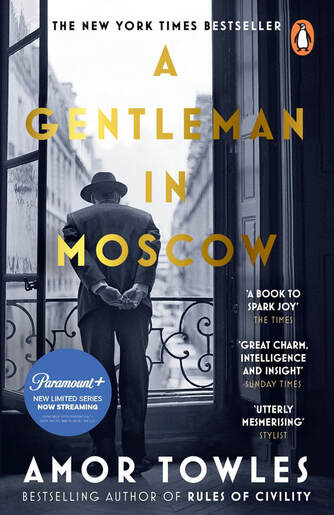
 I was walking out of my local library recently when, on the rack of new books by the entrance, I spotted a book in English. Since I live in the Italian part of Switzerland things in English tend to grab my attention. It was A Gentleman in Moscow, by Amor Towles. Judging a book by its cover (and title) it didn't really seem like my kind of thing (I was unfamiliar with the author, I’m cautious around novels that appear self-consciously “literary”, I don’t really have a connection to Moscow, apart from spy novels…), but the Times of London's cover blurb: "A book to spark joy", got my attention. I feel extraordinarily grateful to be able to say there's quite a bit of joy in my life, but there doesn't seem to be an excess of it floating around, at the moment, so instead of putting it back on the shelf I turned it over and glanced at the back cover. In the end I decided to give it a go pretty much entirely due to that phrase "a book to spark joy" -- what a terrific accolade.
I'm enjoying it enormously. I don't know if it's for everybody, I'm curious about that, but it features a character who takes all of life's challenges -- big, small, pretty huge -- with wit, amused detachment, and the deportment of a gentleman, which I find both entertaining and inspiring. If you think you might enjoy it, leave off here and go order it. I recommend you go into it knowing as little as possible (like eating at one of those novelty darkened restaurants where you don’t know what you’re putting in your mouth, and thus savor its true flavor, rather than your preconceived idea of it). One thing that niggles at the back of my mind as I'm enjoying the urbane, unshakeable, sophisticated charm of the protagonist is that the story seems to take place in an upper class fantasy world; a world where by the mere fact of being born an aristocrat one is safe from most of life’s unpleasantnesses and indignities. Money, of course, doesn’t guarantee happiness, but you could say that poverty very nearly guarantees friction. In that way there is a lighter-than-air quality (that I confess I very much enjoy, provided I don’t over-analyze it) that brings to mind the world of P.G. Wodehouse. The book certainly doesn't have the silliness of Wodehouse, but I keep thinking of instances from Wodehouse such as when Bertie Wooster tells Jeeves (I paraphrase), “I sometimes wonder if freshly pressed trousers matter,” and Jeeves responds something along the lines of, “If you sit down for a moment, the feeling will pass.” I also have my proletarian dad's voice in the back of my head reminding me how much of charming, classic English fiction exists because all of the aristocrats and landed gentry have comfortable incomes from the back-breaking, poorly compensated labor of the serfs on their estates, or something probably much more horrific comfortably far away in the colonies. Where our charming, idle protagonist got his pre-revolution family money, and at what cost in human flourishing, is elided in this delightful book (thus far – I have about a third to go). That’s something I’d love to discuss in the comments, if you have thoughts.
0 Comments
|
AuthorI'm a New Yorker cartoonist, author and illustrator. I'm also a father, a reader with widely varying tastes, an outdoorsman, and generally a curious person. Since I no longer feel like participating in social media, this is where I'll talk about stuff I feel like talking about in public. Feel free to chime in, in the spirit of having a chat over a cup of mint tea on my balcony. Archives
December 2025
Categories |
 RSS Feed