|
I imagine setting out to write a book and get it published is a bit like deciding to run a marathon: you know it’s going to be hard, painful work; at times you’ll wonder what in the world you were thinking, and doubt if it’s worthwhile at all; you'll wonder if maybe you should just give it up and go do something more enjoyable with your time. Perhaps the most telling difference between writing a book and running a marathon (apart from the obvious wear on your shoes) is that when you’re writing a book you wake up the day after and it’s time to start running again! And the same again the next day. And the next. And on and on, for a year or, more likely, years. Some days it’s downhill, and comparatively easy, and then there are days when you’re faced with a steep incline: the day you get notes from your editor often feels like rounding a corner and confronting a vertical wall. I just got notes last week for first book in the graphic novel series I’m working on, and it feels exactly like that. Fortunately, I’ve been down this road before and I’ve learned a few things along the way. The first thing I do is accept that it’s painful to be told that the thing you’ve labored over and loved is imperfect, and it’s scary to find that having given your all to get this far it was actually a false summit and the next climb is even steeper. Who wouldn’t have doubts? I give myself a day or two to be overwhelmed and feel bad about it, and I tell myself, “This is normal, this is okay.” If I feel angry or resentful at the editor, I let those feelings be, too. They’re more about me and my insecurity than they are about the editor. At this point it’s crucial that I don’t respond with a fireball straight to the editor’s face, in spite of the fact that I almost invariably feel that they’re guilty of maligning and perhaps even trying to harm my child. I have a rule: I don’t respond to notes for three days. By that time I’m over the initial shock and feeling that the editor is by-and-large pretty darn near the mark. With a little luck I also have some new ideas by now, and I’m starting to see that the book’s going to be better for them. I'm starting to get excited about the possibilities! “Trust the process” is sort of a cliché in creative fields, but it’s one of those things that gets repeated for good reasons. There’s no way to write a book, or do any sort of original work without it being messy and difficult, just like there’s no way to run a marathon without getting tired legs – it’s part of the process. A factory can stamp out its millionth identical, perfect tin can without a second thought, but who wants to read a tin can? Who wants to hang one on their wall? Imperfection and inefficiency are part of the process -- or rather the process is inefficient and imperfect: how could it be otherwise? There's no mold, no carefully calibrated machine for creating your story: to make something original you have to wing it. You have to show up for the test unprepared, because the answers don't exist yet. Getting notes is part of the process, and for me, hating the notes is part of the process, too. Spending time and energy going down roads that turn out to be dead ends is part of the process. (Who the heck organized this marathon? Where are the signs?!) Having to backtrack, to rewrite, to throw out stuff that was working because what you rewrote to resolve one problem created problems in another area... to feel completely lost – it's all part of the process of creating something original. Fortunately, getting unlost is also part of the process, and if you're lucky enough to have great editors, like me, their notes will help you find the way. As you start to climb that vertical wall it turns out that, while it is pretty darn steep, it isn’t quite as steep as it looked. Little by little you find that you can make it to the next summit. Glancing back, you may be amazed at how far you’ve come, just by trusting the process and putting one foot in front of the other. You can do it. 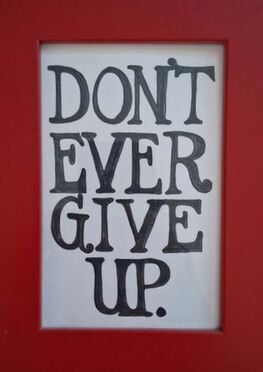 I've had this within eyeshot of my desk since
I first decided I'd get published or bust.
2 Comments
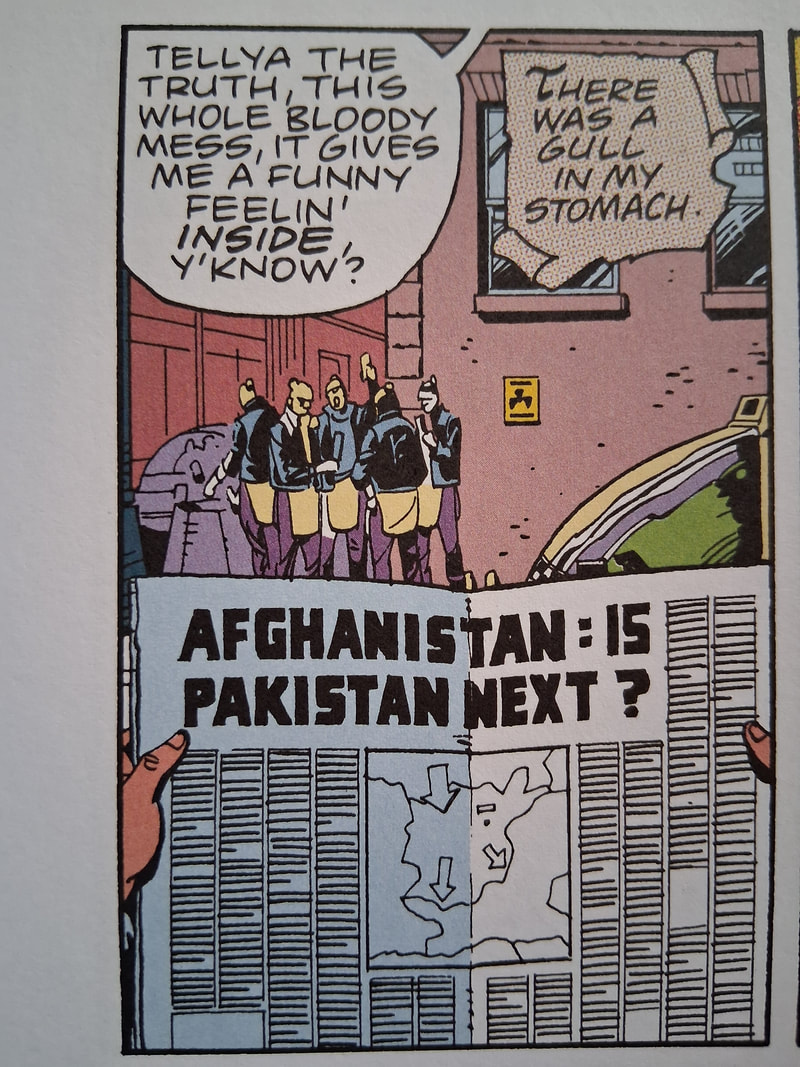
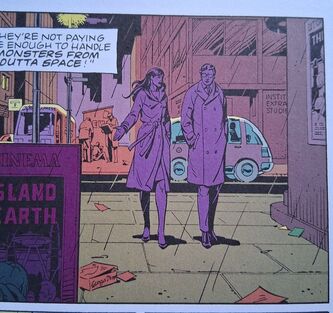
A few weeks ago I reread volume 1 of Promethea, which had been on my nightstand for some time. It was great, and led me to look up what Alan Moore's been doing lately. I read The Great When, his latest book, and the first in a series. The Great When was thoroughly enjoyable, and I'll look forward to the upcoming volumes, but it also reminded me I hadn't read Watchmen in a while. 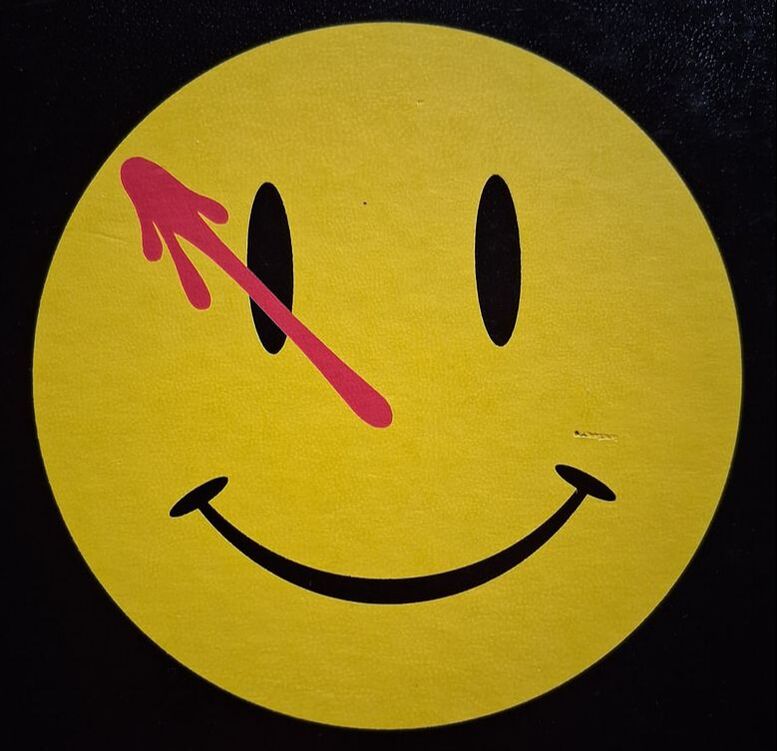 I first read Watchmen as a teenager. I skipped the prose sections, gobbled up the violence, and didn't really understand the ending. (Basically the way I imagine the director of the Watchmen film read it.) I read it again in my twenties and I was blown away. Watchmen and Scott McCloud's Making Comics convinced me it was worthwhile to keep reading comics into adulthood, and even to try my hand at making 'em. Watchmen was so utterly, amazingly, astoundingly good that I read it almost annually for the next decade, or so, and I always found some new layer, some clever allusion I'd missed, some overlooked detail. Now it had been a few years, and I wondered if it would still hold up, if it could possibly serve up any new facets. Honestly, I was pretty doubtful. I went into the reread with the familiar sinking feeling that I was about to discover that something that had been important to me didn't hold up to scrutiny, now that I was older -- and I couldn't have been more wrong. Within the first few pages I spotted a newspaper headline mentioning that Vietnam had become the 51st state. A small detail, but one which enriches an already rich, fully imagined world. The story drew me in and I was hooked. Below are a few things that made this reread so thoroughly enjoyable. Look how neatly these two images, which show the same scene from different angles, mirror each other? I actually don't love Dave Gibbons's art, but he was the perfect artist for this book.
I spotted loads of things like that (I think it helped that I was reading the "absolute" edition, with extra large pages), lots of details of characters entering or leaving the scene in the background, lots of examples of the extraordinary clarity of the book's geography.
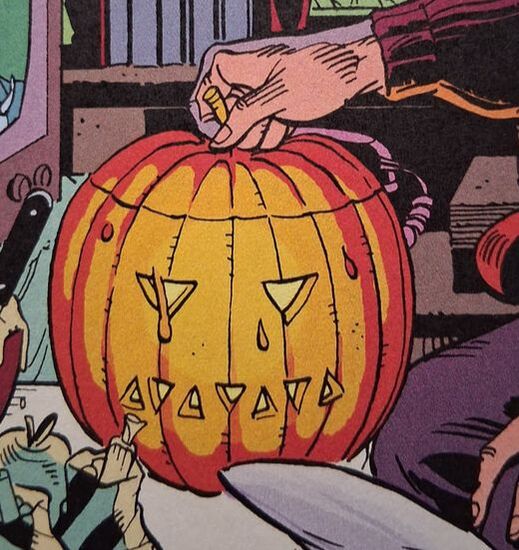
What may have surprised me most of all was the book's humor. 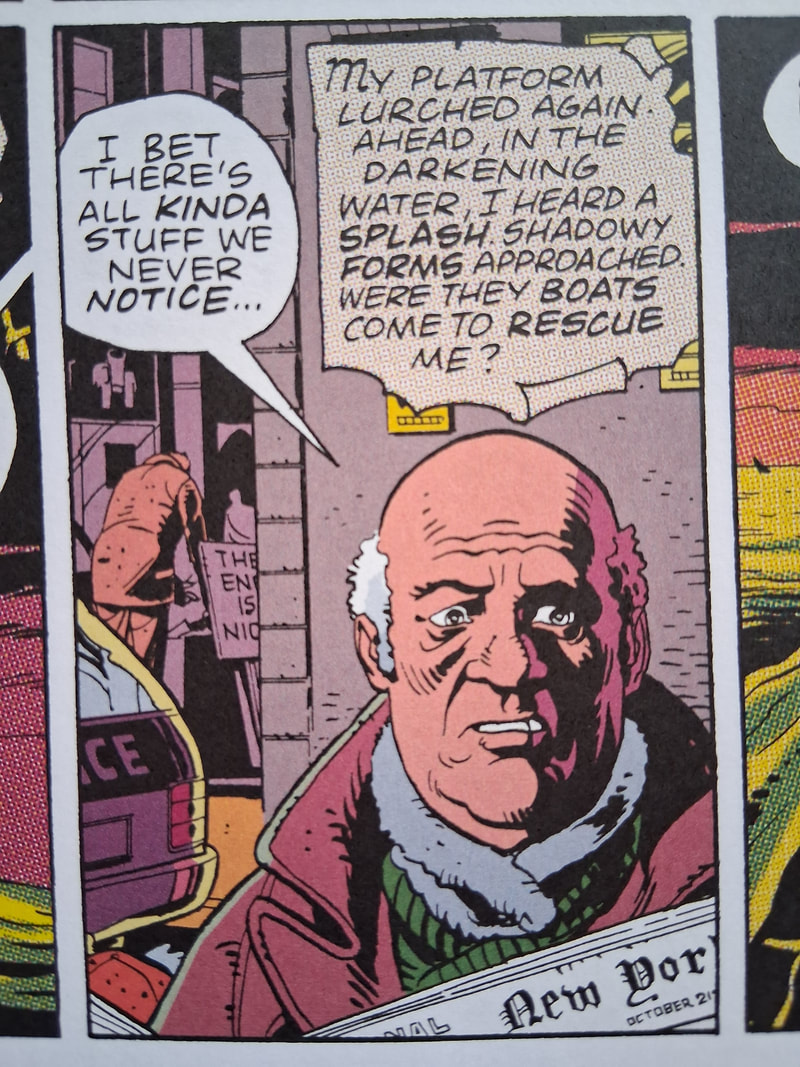 (As Rorschach checks his letter-drop in the background.) Or this one: 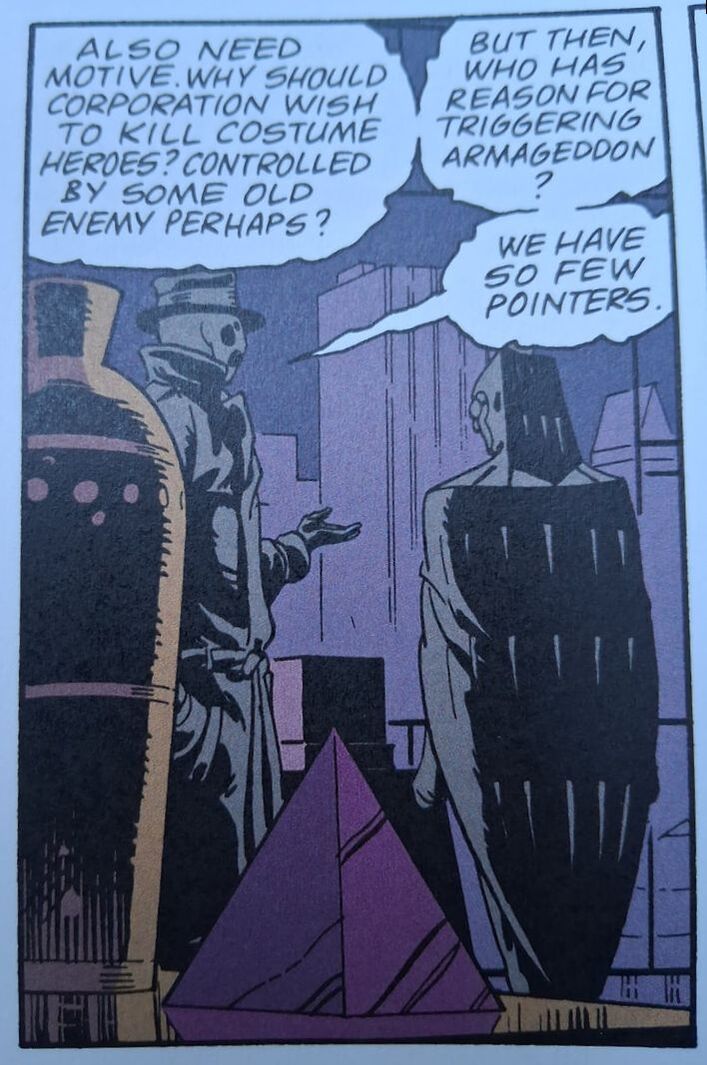 It's always fun to spot all the repetitions of the motif of the smiley pin with the streak of blood over its eye. I only just noticed how the moon becomes the yellow circle of the smiley pin in the one below, on the right, as I was cropping the image. That's what makes talking and writing about these things worthwhile, I think -- you discover stuff along the way.
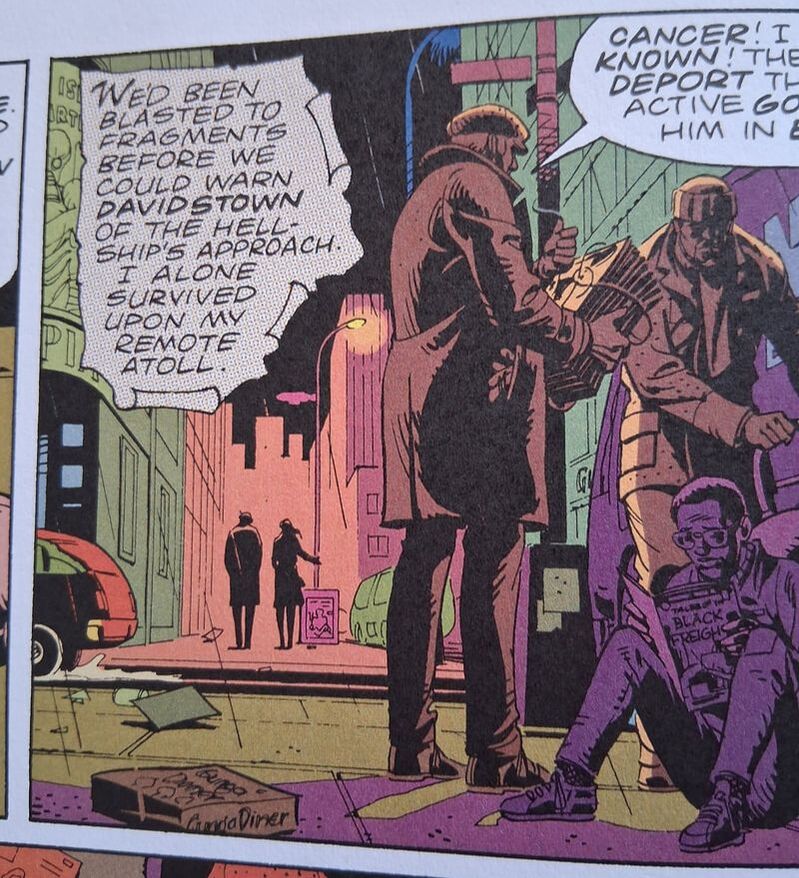
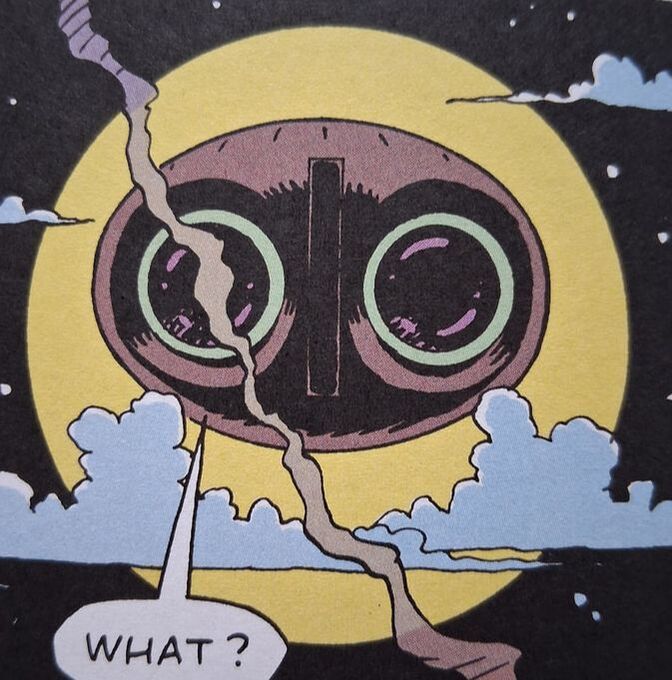
Some, like the ones above, are obviously intentional, but once you're on the lookout you see it everywhere, and the question arises whether it was intentional or not. What do you think of that oddly-shaped, broken piling in front of the eye of the owl-ship, below? 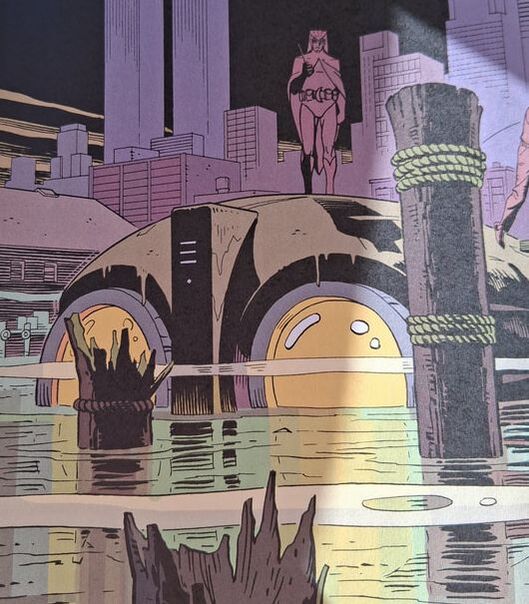 Below is an example of a wonderful detail I never before noticed: the way Jon and Laurie's disappearance from the scene reveals the haunting graffiti silhouette of a couple kissing (that was spray-painted on the wall earlier in the book). I don't know what it means, but it makes my heart ache. To me, this is comics at its best, conveying something ineffable with pure imagery. In the wake of the destruction of the neighborhood it seems to suggest something about war, and the grim shadows of obliterated people left on the walls of Hiroshima, but also hint at something poignant and heartbreaking in the end of Jon and Laurie's long romantic relationship. So few comics reward slow reading and close examination, but this one -- wow. 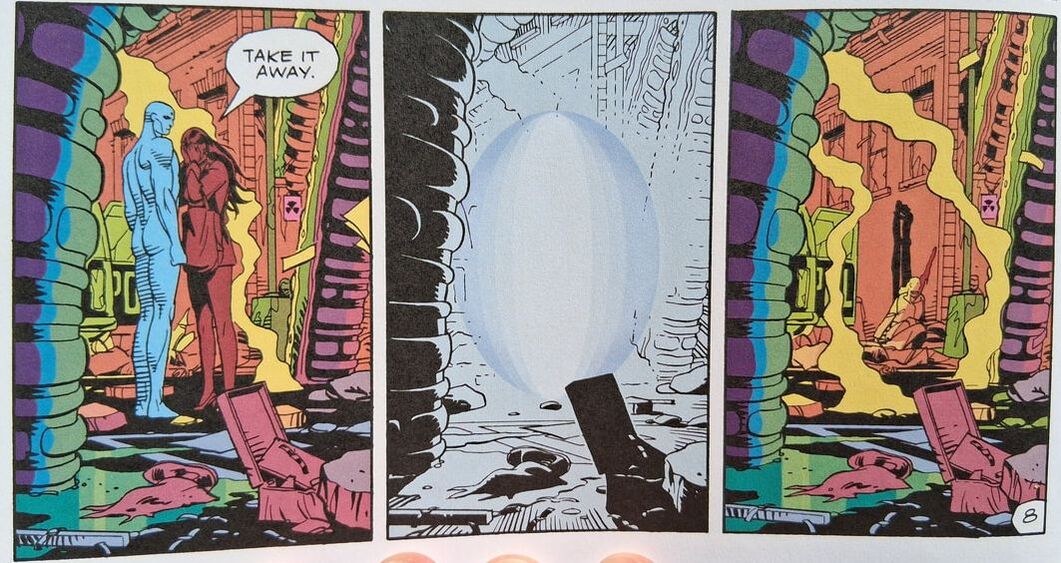 In praise of the book's amazing visual storytelling I have to draw attention to this superbly chilling "dolly-in" on Rorschach, as everyone's gradually coming to the conclusion they'll have to side with Adrian in order that all the killing won't have been in vain. 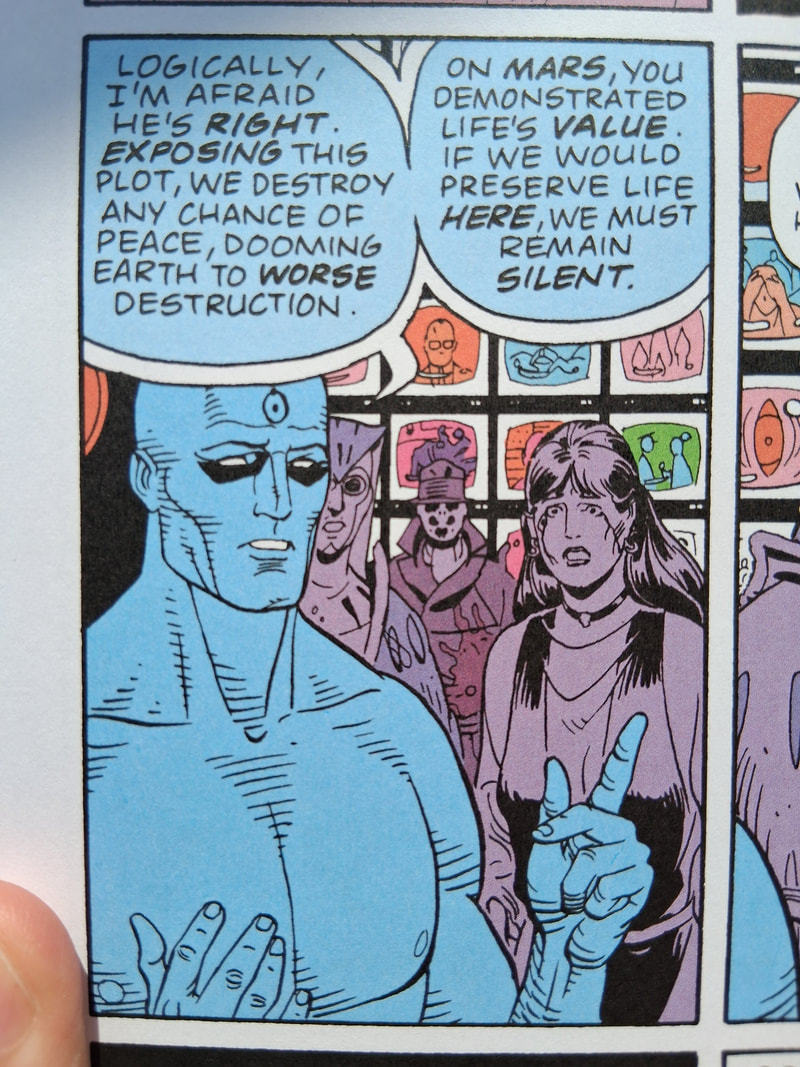 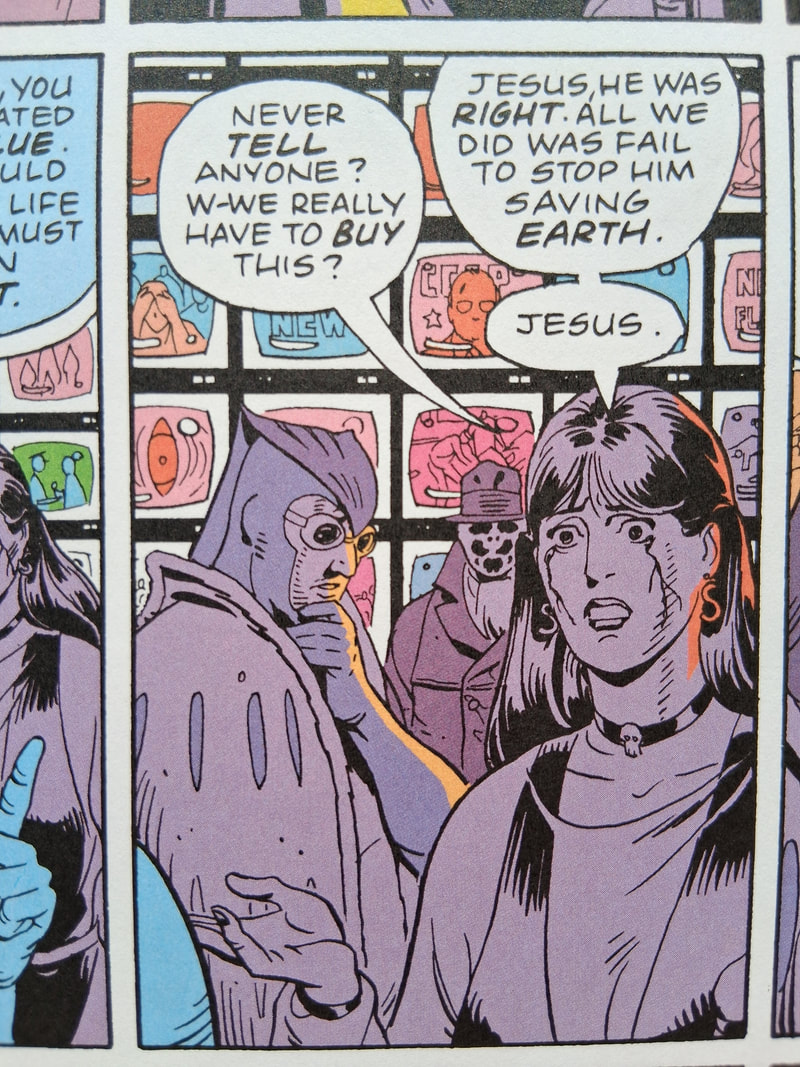 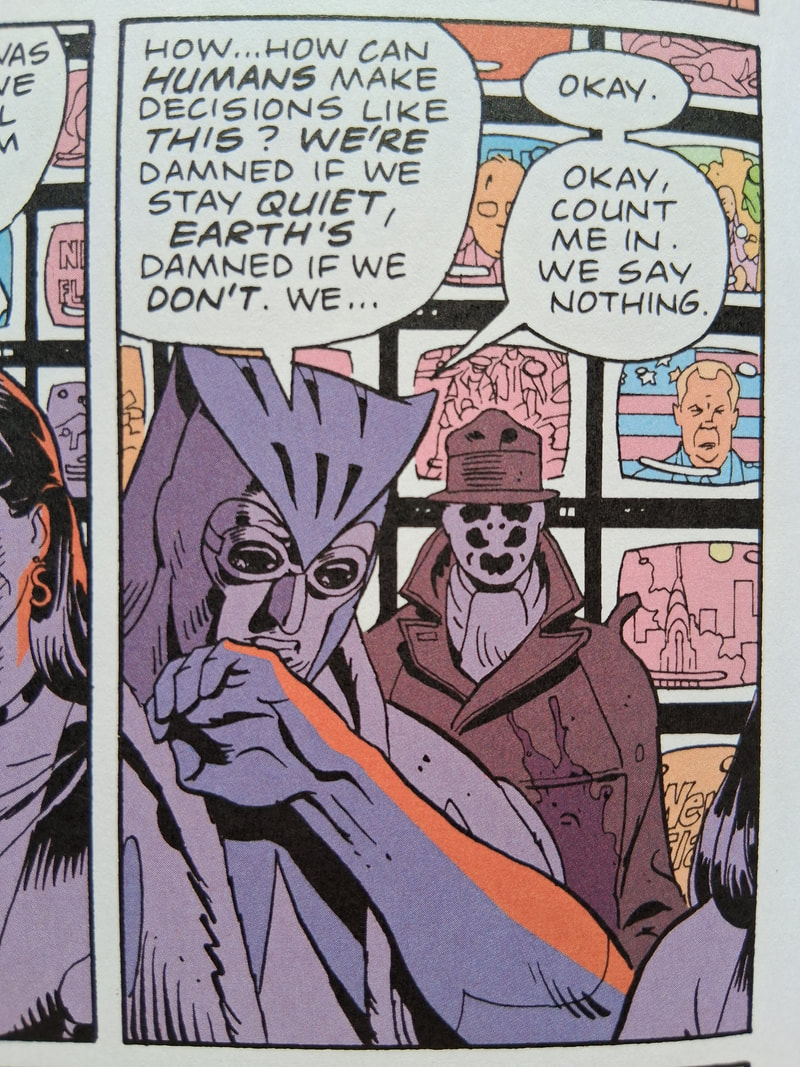 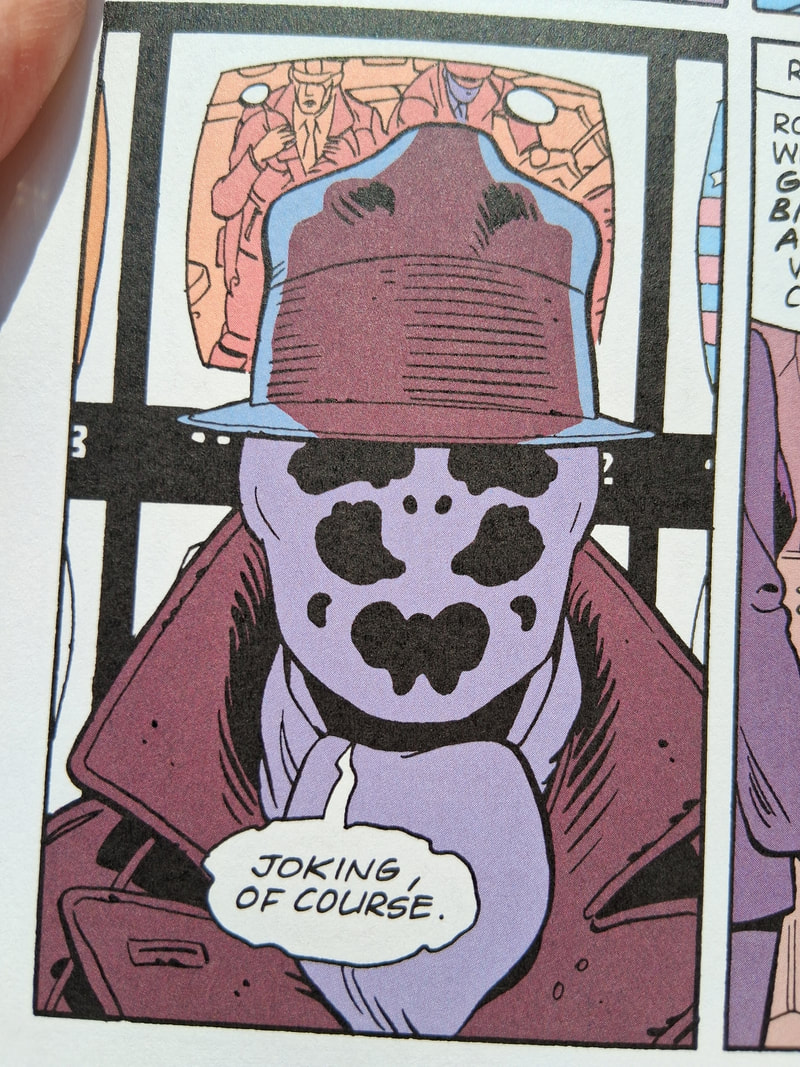 But perhaps the biggest surprise to me was how one character with a fairly small role grew in my esteem. I always thought Dr Malcolm Long, Rorschach's prison therapist, was a fatuous character, who gets his comeuppance when his pampered, superficial naivete is ripped away from him and he gradually awakens to the fact that life is far stranger and darker than he's ever imagined. What I didn't remember was how his character arc ended. It wasn't till now -- when I'm 45, divorced, and have had a taste of heartbreak and hardship -- that I was able to fully grasp the nobility he displays by making the choice to help, to choose kindness, in spite of everything, and at the imminent risk of losing everything. On this reread, for me, he went from being a secondary character to perhaps the heart of the book. 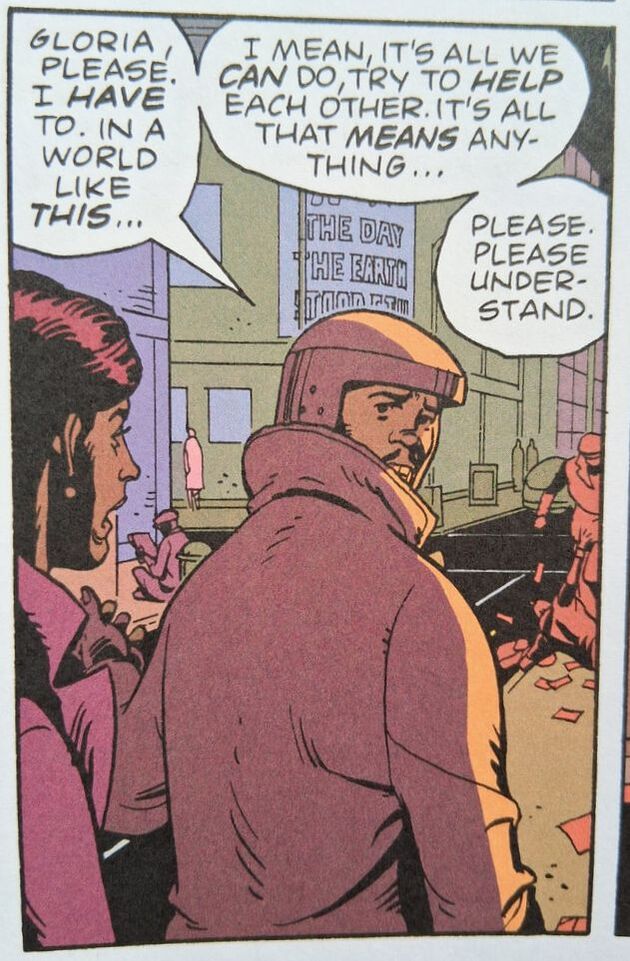 Dr Malcolm Long: actual, honest-to-goodness hero. That's all I've got to say, till I read the book again in six months or a year. My hat's off to Mr Moore and Mr Gibbons, and everyone who worked on the book. (I actually wrote a fan letter to Mr Moore, something I've always meant to do. I don't expect to hear back from him, but I hope he'll read it.) I'll leave you with this: Look how weird early designs were for Rorschach's costume! (From the "absolute" edition.) 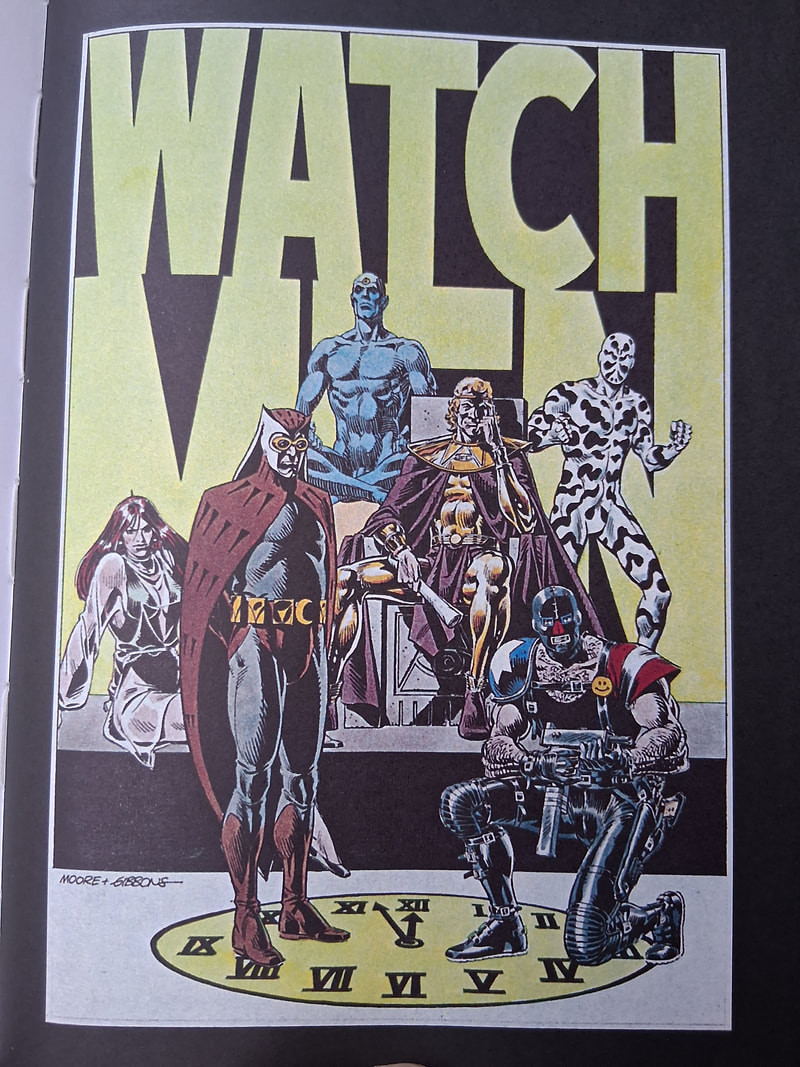 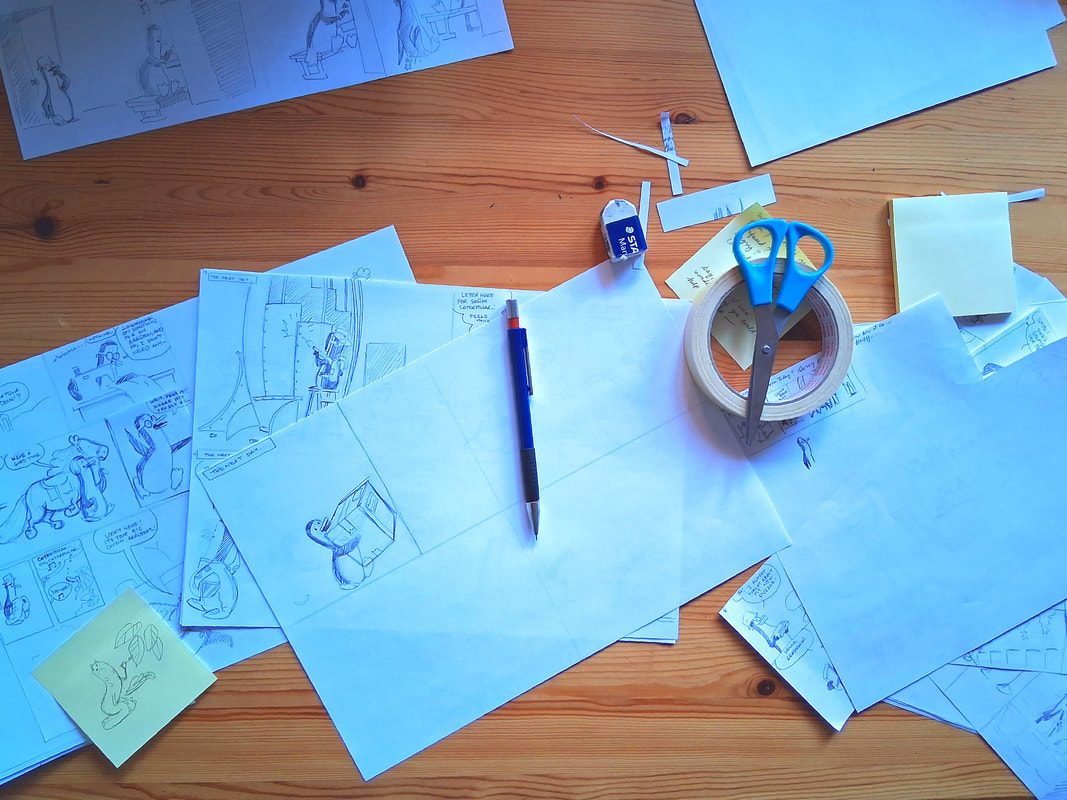 I'm writing the fourth or fifth draft of a picture book. Suddenly it's starting to come together, starting to feel like a real story, like I actually know what I'm doing. The big lesson for me over the past decade I've spent doing this professionally is to trust the process: every draft is a step in the right direction; if it stinks you just haven't done enough drafts, yet.
Don't get irate, iterate. What I love about iterating, about knowing I'm working on a draft which will be followed by another (and another), is that it takes the pressure off me to get it right. All I need to be doing is moving, working, writing -- any progress is a product of that, the new ideas that bring a project to life come from sitting with the thing and doing the work. (This is something that I think is missing from the various AI shortcuts people have been promoting to me, lately: if you spend a minute putting a prompt into a chatbot you'll get a minute's-worth of your own ideas; spend hours doing it yourself and you'll get a whole lot more -- it's basically the same principle as steeping a tea bag.) When I'm iterating I'm not a sculptor removing all the bits of marble that aren't my perfect statue, what I'm working with is something more like a hunk of clay that I can keep reworking till I create something pleasing enough that I want to tidy it up and keep it. Like you, like everyone, I still struggle to sit down and get to work, but a lot less than when I feel the pressure of having to produce something magnificent. When I'm doing creative work I have to basically throw away the idea of efficiency. I have to accept that I'm not doing a straightforward job like digging a hole, where there are a certain number of shovelfuls of dirt that I need to remove and the sooner I get them out of there -- bigger shovel, more umph -- the sooner I'll be done. I don't even know what I'm digging yet! If you come from a blue collar background, like I do, this is not easy, but I do my best to slow down and enjoy the process. I'll work on a sketch till it's more complete than would be absolutely necessary, if I feel like it. Who knows what I'll discover along the way? If I write a scrap of dialogue and suddenly it turns into a lengthy conversation, I'll go along for the ride. A lot of this will get thrown out (inefficient!), but by relaxing, playing along, I might discover something startling and wonderful. It's like looking for diamonds on a foggy day: you can't see them from camp, you have to start walking into the fog and hope you're going in the right direction. There are diamonds out there, scattered around. If you haven't found any then you haven't walked around enough. A few things I do: I check to make sure my internal dialogue is positive. I suspect that if I'm having a hard time getting started, if I'm not "inspired", it's because my internal dialogue needs to change from "everyone is going to hate this, I'm no good at this, what's the point?" to "I'm making something I care about, it's worthwhile, (and I must find time to write that Oscars acceptance speech!)". For the past couple of years I've been writing with pencils and pens on paper as much as I can. I find it much easier to write a first draft, and much easier to resist the urge to cut and paste and begin rearranging already; easier to push through and have a finished draft, which is what I need at this stage. Revising and polishing early drafts is what Lawrence Block unforgettably described as "washing garbage". When it's time to rewrite it's better to actually write it again than it is to cut and paste -- things will change for the better, and it will take longer -- which is good, your tea will be richer! I'm using scissors and tape to assemble parts of this latest draft, and not only is it slow and inefficient (which is good!) it's an utter, absolute joy, like doing an elementary school project. I put my phone not just out of reach, but out of sight. Sometimes I set an (analog) timer for 45 minutes or an hour, and during that time I'm not allowed to do anything but work, not even laudable things like write a birthday card to an elderly relative or clean the bathroom (although I can write those things on a list of things to do instead of scrolling social media later today). And this might be just me, but lately, I've been really liking to put in a pair of earplugs when I work. It's not noisy here, but somehow they help me concentrate and they make a sort of soothing white noise in my ears that's almost like having something to listen to. It's also a nice ritual. Perhaps most of all, it keeps ideas from escaping out my ears, and makes sure the only place they can go is into my writing hand. 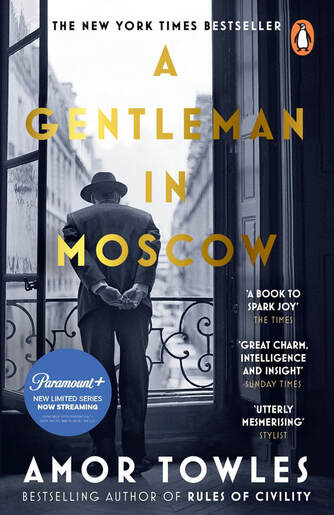 I was walking out of my local library recently when, on the rack of new books by the entrance, I spotted a book in English. Since I live in the Italian part of Switzerland things in English tend to grab my attention. It was A Gentleman in Moscow, by Amor Towles. Judging a book by its cover (and title) it didn't really seem like my kind of thing (I was unfamiliar with the author, I’m cautious around novels that appear self-consciously “literary”, I don’t really have a connection to Moscow, apart from spy novels…), but the Times of London's cover blurb: "A book to spark joy", got my attention. I feel extraordinarily grateful to be able to say there's quite a bit of joy in my life, but there doesn't seem to be an excess of it floating around, at the moment, so instead of putting it back on the shelf I turned it over and glanced at the back cover. In the end I decided to give it a go pretty much entirely due to that phrase "a book to spark joy" -- what a terrific accolade.
I'm enjoying it enormously. I don't know if it's for everybody, I'm curious about that, but it features a character who takes all of life's challenges -- big, small, pretty huge -- with wit, amused detachment, and the deportment of a gentleman, which I find both entertaining and inspiring. If you think you might enjoy it, leave off here and go order it. I recommend you go into it knowing as little as possible (like eating at one of those novelty darkened restaurants where you don’t know what you’re putting in your mouth, and thus savor its true flavor, rather than your preconceived idea of it). One thing that niggles at the back of my mind as I'm enjoying the urbane, unshakeable, sophisticated charm of the protagonist is that the story seems to take place in an upper class fantasy world; a world where by the mere fact of being born an aristocrat one is safe from most of life’s unpleasantnesses and indignities. Money, of course, doesn’t guarantee happiness, but you could say that poverty very nearly guarantees friction. In that way there is a lighter-than-air quality (that I confess I very much enjoy, provided I don’t over-analyze it) that brings to mind the world of P.G. Wodehouse. The book certainly doesn't have the silliness of Wodehouse, but I keep thinking of instances from Wodehouse such as when Bertie Wooster tells Jeeves (I paraphrase), “I sometimes wonder if freshly pressed trousers matter,” and Jeeves responds something along the lines of, “If you sit down for a moment, the feeling will pass.” I also have my proletarian dad's voice in the back of my head reminding me how much of charming, classic English fiction exists because all of the aristocrats and landed gentry have comfortable incomes from the back-breaking, poorly compensated labor of the serfs on their estates, or something probably much more horrific comfortably far away in the colonies. Where our charming, idle protagonist got his pre-revolution family money, and at what cost in human flourishing, is elided in this delightful book (thus far – I have about a third to go). That’s something I’d love to discuss in the comments, if you have thoughts. Isn't this just a blog?
I guess. Maybe I should call it that, and maybe I will -- it's just a word, after all, and specificity is something I admire -- but I've always found it an off-putting word. Blog sounds like "blah" to me, it sounds like the noise congealed soup makes when you dump it in the trash, it sounds like stepping in a cowpie. Meanwhile, to my ear, "journal" and "diary" and "notebook" sound like an early morning walk, enjoying the solitude, the day's unspoiled potential, and one's own thoughts -- and perhaps stopping and jotting down a reflection or a sketch. A blog feels like signing up for something and being obligated to do it a certain way, while a notebook is mine, and I can do with it what I like. Haven't you ever heard of social media? Didn't Facebook, Twitter, and Instagram make blogging obsolete? Okay, first of all, it's a notebook. Second of all, social media makes me feel crummy about myself. I do use Facebook and Instagram sporadically, and I kind of like Instagram sometimes, but if I exert effort creating a post I usually feel like I've lost a bunch of time, and then I feel drawn to check on how it's doing, respond to comments (promptly, to milk the algorithm), and I frequently find that my day becomes a fragmented, unfocused blur that feels yucky to me; so then I don't post for a while, and I feel negligent for not "building my platform". I get the sense that some people who've successfully built a large following are actually enjoying themselves, but it feels like work to me, and unappetizing work at that. Maybe that's because in the back of my mind I know that I'm being used as free labor to keep the wheels of the social media machine turning. Let me see if I can explain what I mean. It's like each of us is digging a hole, working hard, feeling good about the progress we're making, and really we're down at the bottom of a massive pit that belongs to a huge corporation, and the heads of the corporation are outside the pit, looking down, and all they see is ant-sized miners excavating their pit for them. (And that little hole you've been working on so diligently? It doesn't belong to you; they can take it away from you in a second. *) Then there's my chronic smartphone addiction -- and yours, too. I'm in a constant struggle with my phone, and how could I not be, when the entire mission of manufacturers, app developers, and social media companies is to get me to use it more. I hate it that by posting I become unpaid labor in an organization whose overarching goal is to separate you from the minutes and hours of your life as surely as a pickpocket's goal is to separate you from your wallet. We've probably all heard about the muckety-muck at Netflix who said that their biggest competitor wasn't other streaming services, but sleep. Can you imagine having such a cavalier attitude toward the well-being of other human beings? But we could easily adapt that to the subject of social media: Facebook, Twitter, and Instagram's major competitors aren't each other, they're your kids, your husband or wife, your work, your community. Aren't you worried no one will care that you have a blog? It is a blog, isn't it. Fine. Am I worried? Nope. If someone does come by it will mean they sought me out, not that I was just a piece of content in their scroll. I like that. I don't want to be content. The creators I grew up admiring made art; I'm dismayed when I see artists degrading themselves by referring to their self-expression as content -- like a low-paid worker referring to themselves as "a human resource". As I may have mentioned, I have mixed feelings about social media. For example, when my daughter was born I was careful not to post about it; it just made me feel queasy to imagine one of the most marvelous and consequential moments of my life being weighed by an algorithm and plopped into somebody's social media feed where, at the same moment that I was gazing in wonder at the new life in my arms, somebody might click "like", before scrolling on (in all probability to "like", likewise, a post about someone going to bed early or making chili or something). And yet, I do want people to know about me, to buy my books, to hire me. Sometimes I want to tell the world about something really good I read, or a cool word I learned -- and I'll do that here. Maybe I'll share stuff I'm working on. Maybe we'll chat in the comments, and maybe it will feel less yucky; more like stopping by for a visit and drinking apple cider at a table under a tree, while we chat, rather than shouting to be heard in a manky disco. Today is going to be a great day. --- Footnote: * I know a woman whose Facebook account was frozen because someone reported one of her photos. She entered into a weird world of automated appeals straight out of Kafka. Her appeal was denied and she lost access to her account, where she'd been "building her platform" for ten years. Throughout the process she never spoke to a human being and never knew what photo triggered the whole ordeal. She's still banned from Facebook. |
AuthorI'm a New Yorker cartoonist, author and illustrator. I'm also a father, a reader with widely varying tastes, an outdoorsman, and generally a curious person. Since I no longer feel like participating in social media, this is where I'll talk about stuff I feel like talking about in public. Feel free to chime in, in the spirit of having a chat over a cup of mint tea on my balcony. Archives
December 2025
Categories |
 RSS Feed