
|
I imagine setting out to write a book and get it published is a bit like deciding to run a marathon: you know it’s going to be hard, painful work; at times you’ll wonder what in the world you were thinking, and doubt if it’s worthwhile at all; you'll wonder if maybe you should just give it up and go do something more enjoyable with your time. Perhaps the most telling difference between writing a book and running a marathon (apart from the obvious wear on your shoes) is that when you’re writing a book you wake up the day after and it’s time to start running again! And the same again the next day. And the next. And on and on, for a year or, more likely, years. Some days it’s downhill, and comparatively easy, and then there are days when you’re faced with a steep incline: the day you get notes from your editor often feels like rounding a corner and confronting a vertical wall. I just got notes last week for first book in the graphic novel series I’m working on, and it feels exactly like that. Fortunately, I’ve been down this road before and I’ve learned a few things along the way. The first thing I do is accept that it’s painful to be told that the thing you’ve labored over and loved is imperfect, and it’s scary to find that having given your all to get this far it was actually a false summit and the next climb is even steeper. Who wouldn’t have doubts? I give myself a day or two to be overwhelmed and feel bad about it, and I tell myself, “This is normal, this is okay.” If I feel angry or resentful at the editor, I let those feelings be, too. They’re more about me and my insecurity than they are about the editor. At this point it’s crucial that I don’t respond with a fireball straight to the editor’s face, in spite of the fact that I almost invariably feel that they’re guilty of maligning and perhaps even trying to harm my child. I have a rule: I don’t respond to notes for three days. By that time I’m over the initial shock and feeling that the editor is by-and-large pretty darn near the mark. With a little luck I also have some new ideas by now, and I’m starting to see that the book’s going to be better for them. I'm starting to get excited about the possibilities! “Trust the process” is sort of a cliché in creative fields, but it’s one of those things that gets repeated for good reasons. There’s no way to write a book, or do any sort of original work without it being messy and difficult, just like there’s no way to run a marathon without getting tired legs – it’s part of the process. A factory can stamp out its millionth identical, perfect tin can without a second thought, but who wants to read a tin can? Who wants to hang one on their wall? Imperfection and inefficiency are part of the process -- or rather the process is inefficient and imperfect: how could it be otherwise? There's no mold, no carefully calibrated machine for creating your story: to make something original you have to wing it. You have to show up for the test unprepared, because the answers don't exist yet. Getting notes is part of the process, and for me, hating the notes is part of the process, too. Spending time and energy going down roads that turn out to be dead ends is part of the process. (Who the heck organized this marathon? Where are the signs?!) Having to backtrack, to rewrite, to throw out stuff that was working because what you rewrote to resolve one problem created problems in another area... to feel completely lost – it's all part of the process of creating something original. Fortunately, getting unlost is also part of the process, and if you're lucky enough to have great editors, like me, their notes will help you find the way. As you start to climb that vertical wall it turns out that, while it is pretty darn steep, it isn’t quite as steep as it looked. Little by little you find that you can make it to the next summit. Glancing back, you may be amazed at how far you’ve come, just by trusting the process and putting one foot in front of the other. You can do it. 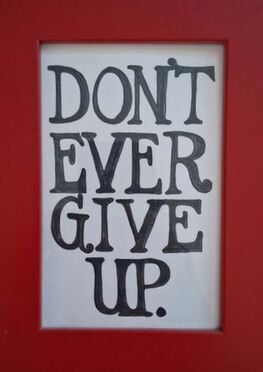 I've had this within eyeshot of my desk since
I first decided I'd get published or bust.
2 Comments
12/6/2025 07:38:07 am
Painful enough having to make changes on a single illustration--I can't imagine what it would be like to have to face the same kind of thing with an entire book, even at its beginning stages! Having a relationship with editors you trust must be an enormous advantage. The first time working with an editor, even a great one, must have been a real dash of cold water. "Who does this person think they are?!"
Liam
12/7/2025 03:35:25 am
Hi Jim! Yeah, the reason the three-day period before responding is an important innovation for me is because unfortunately it didn't used to exist. Leave a Reply. |
AuthorI'm a New Yorker cartoonist, author and illustrator. I'm also a father, a reader with widely varying tastes, an outdoorsman, and generally a curious person. Since I no longer feel like participating in social media, this is where I'll talk about stuff I feel like talking about in public. Feel free to chime in, in the spirit of having a chat over a cup of mint tea on my balcony. Archives
December 2025
Categories |
 RSS Feed